The 3D models and textures listed here come from open sources. Each one is shown with who made it, its licence, and what we changed so it runs well on a phone.
Biology
17 yo Female, Normal Heart
M.T. Bramlet and B.S. Cross · NIH 3D, entry 3DPX-002636
Licence: Public domain
Bramlet, M.T., Cross, B.S. (2016). 17 yo Female, Normal Heart. Resource document. NIH 3D Print Exchange.
What we changed: The whole heart (ALM0006_Whole.stl): decimated to the triangle count given below, smooth normals, centred, millimetres to metres, then quantised and meshopt-compressed into a GLB.
The file we serve: bio-heart-whole.glb, 49,854 triangles in 1 part, 322 KB.
17 yo Female, Normal Heart (sliced sagittally)
slarochelle0769, a remix of the heart by M.T. Bramlet and B.S. Cross · NIH 3D, entry 3DPX-007207
Licence: Public domain
17 yo Female, Normal Heart (sliced sagittally), by slarochelle0769 (NIH 3D 3DPX-007207), a remix of Bramlet, M.T., Cross, B.S. (2016). 17 yo Female, Normal Heart. NIH 3D Print Exchange.
What we changed: The two halves (heart_pt1 and heart_pt2) kept as separate parts, heart_half_1 (the back) and heart_half_2 (the front), centred together; decimated to the triangle count given below, smooth normals, millimetres to metres, then quantised and meshopt-compressed into a GLB. The source has no separate chambers: the cut shows them.
The file we serve: bio-heart-chambers.glb, 55,872 triangles in 2 parts, 358 KB.
3D Reference Organ for Lung, Male v1.3
Kristen Browne and Heidi Schlehlein, Human Reference Atlas (HuBMAP) · Human Reference Atlas 3D Reference Object Library
Licence: CC BY 4.0
Kristen Browne; Heidi Schlehlein. 2023. 3D Reference Organ for Lung, Male v1.3. https://doi.org/10.48539/HBM737.FFBT.876 (CC BY 4.0)
What we changed: Every part kept as its own node by its atlas name (the lung segments, hila and intrapulmonary bronchi); parts over 2,500 triangles decimated, from 224,765 triangles in all to the count given below; vertex colours, tangents and UVs dropped; smooth normals; quantised and meshopt-compressed GLB. This version of the atlas lung has no trachea and no main bronchi: those are two separate files in the same body frame.
The file we serve: bio-lungs-bronchial.glb, 57,901 triangles in 58 parts, 510 KB.
3D Reference Organ for Trachea, Male v1.0
Kristen Browne and Heidi Schlehlein, Human Reference Atlas (HuBMAP) · NIH 3D, entry 3DPX-021021
Licence: CC BY 4.0
Kristen Browne; Heidi Schlehlein. 2023. 3D Reference Organ for Trachea, Male v1.0. https://doi.org/10.48539/HBM969.WCCJ.636 (CC BY 4.0)
What we changed: The three parts kept as nodes (trachea, tracheal cartilage, carina); not decimated; tangents and UVs dropped; smooth normals; quantised and meshopt-compressed GLB. It ends at the carina, where the two main bronchi begin: they are a separate file in the same body frame, which joins it to the lung.
The file we serve: bio-trachea.glb, 44,042 triangles in 3 parts, 274 KB.
3D Reference Organ for Main Bronchus, Male v1.1
Kristen Browne and Heidi Schlehlein, Human Reference Atlas (HuBMAP) · Human Reference Atlas 3D Reference Object Library
Licence: CC BY 4.0
Browne, Kristen, and Heidi Schlehlein. 2024. "3D Reference Organ for Main Bronchus, Male v1.1." https://doi.org/10.48539/HBM373.XHXV.928 (CC BY 4.0)
What we changed: The four parts kept as nodes by their atlas names (the left and right main bronchi and the cartilage of each); not decimated; tangents and UVs dropped; smooth normals; quantised and meshopt-compressed GLB. In the same body frame as the trachea and the lung: each main bronchus runs from the carina to its lung's lobar bronchi, so the three files make one airway.
The file we serve: bio-main-bronchi.glb, 6,023 triangles in 4 parts, 48 KB.
BodyParts3D 4.0: diaphragm, sternum, ribs and costal cartilages
The Database Center for Life Science (DBCLS) · BodyParts3D, in the LSDB Archive
Licence: CC BY 4.0
BodyParts3D, © The Database Center for Life Science licensed under CC Attribution 4.0 International
What we changed: Each structure kept as a node named as the database names it: the diaphragm, the sternum (manubrium, body and xiphoid process joined), 24 ribs and 14 costal cartilages; parts over 2,500 triangles decimated to the triangle count given below in all; smooth normals; millimetres to metres, stood up in y, centred on the rib cage; quantised and meshopt-compressed GLB. No spine: the ribs end at the back where the vertebrae would be.
The file we serve: bio-diaphragm-ribcage.glb, 57,970 triangles in 40 parts, 429 KB.
BodyParts3D 4.0: skin (head and trunk)
The Database Center for Life Science (DBCLS) · BodyParts3D, in the LSDB Archive
Licence: CC BY 4.0
BodyParts3D, © The Database Center for Life Science licensed under CC Attribution 4.0 International
What we changed: The skin (FMA7163, one part) cut off at the hips, about 93 cm above the soles, so it keeps the head, the trunk and the upper arms, and no legs, hands or genitals: a see-through ghost around the organs. Then decimated to the triangle count given below; smooth normals; millimetres to metres, stood up in y and centred on the same point as the rib cage above, so the two fit together; quantised and meshopt-compressed GLB.
The file we serve: bio-body-shell.glb, 30,000 triangles in 1 part, 189 KB.
BodyParts3D 4.0: the body, skin
The Database Center for Life Science (DBCLS) · BodyParts3D, in the LSDB Archive
Licence: CC BY 4.0
BodyParts3D, © The Database Center for Life Science licensed under CC Attribution 4.0 International
What we changed: The skin (FMA7163) made neutral: the groin, with its genital form, cut away and closed with a smooth surface relaxed over the cut, and the pubic hair part left out, so the outer body has no genitals. Then parts merged into one node per organ (named by its FMA id), decimated to the triangle count given below, smooth normals, millimetres to metres in one body frame shared by every body file (y up, facing forward, the origin on the floor between the feet), quantised and meshopt-compressed GLB.
The file we serve: skin.glb, 99,998 triangles in 1 part, 593 KB.
BodyParts3D 4.0: the body, skeleton
The Database Center for Life Science (DBCLS) · BodyParts3D, in the LSDB Archive
Licence: CC BY 4.0
BodyParts3D, © The Database Center for Life Science licensed under CC Attribution 4.0 International
What we changed: Parts merged into one node per organ (named by its FMA id), decimated to the triangle count given below, smooth normals, millimetres to metres in one body frame shared by every body file (y up, facing forward, the origin on the floor between the feet), quantised and meshopt-compressed GLB.
The file we serve: skeleton.glb, 132,918 triangles in 16 parts, 868 KB.
Close-up files: Close-up files of single organs, loaded only when that organ is named: the same BodyParts3D parts at a finer triangle count. Soft organs cut into segments (the liver, the lungs, the brain, the heart, the gut) are fused into one smooth outer surface, so the cuts between segments do not show. Quantised and meshopt-compressed GLB, most with a lighter copy for phones. Jawbone (mandible) (jaw.glb, 5,576 triangles, 38 KB; jaw-phone.glb, 5,576 triangles, 38 KB) · Hyoid bone (hyoid.glb, 2,392 triangles, 12 KB; hyoid-phone.glb, 2,392 triangles, 12 KB) · Nose cartilage (nose-cartilage.glb, 2,094 triangles, 16 KB; nose-cartilage-phone.glb, 2,094 triangles, 16 KB) · Skull (skull.glb, 41,292 triangles, 267 KB; skull-phone.glb, 27,532 triangles, 181 KB) · Spine (backbone) (spine.glb, 42,066 triangles, 263 KB; spine-phone.glb, 28,080 triangles, 178 KB) · Rib cage (rib-cage.glb, 65,998 triangles, 416 KB; rib-cage-phone.glb, 44,000 triangles, 281 KB) · Hip bones (pelvis) (pelvis.glb, 4,706 triangles, 33 KB; pelvis-phone.glb, 4,706 triangles, 33 KB) · Collarbones (clavicles) (collarbones.glb, 2,322 triangles, 17 KB; collarbones-phone.glb, 2,322 triangles, 17 KB) · Shoulder blades (shoulder-blades.glb, 32,000 triangles, 195 KB; shoulder-blades-phone.glb, 16,000 triangles, 101 KB) · Upper arm bones (humerus) (upper-arms.glb, 7,628 triangles, 49 KB; upper-arms-phone.glb, 7,628 triangles, 49 KB) · Forearm bones (radius and ulna) (forearms.glb, 2,962 triangles, 21 KB; forearms-phone.glb, 2,962 triangles, 21 KB) · Hand bones (hands.glb, 19,948 triangles, 124 KB; hands-phone.glb, 16,000 triangles, 100 KB) · Thigh bones (femur) (thighs.glb, 6,306 triangles, 42 KB; thighs-phone.glb, 6,306 triangles, 42 KB) · Shin bones (tibia and fibula) (shins.glb, 5,622 triangles, 38 KB; shins-phone.glb, 5,622 triangles, 38 KB) · Foot bones (feet.glb, 30,326 triangles, 192 KB; feet-phone.glb, 16,000 triangles, 104 KB).
BodyParts3D 4.0: the body, muscles
The Database Center for Life Science (DBCLS) · BodyParts3D, in the LSDB Archive
Licence: CC BY 4.0
BodyParts3D, © The Database Center for Life Science licensed under CC Attribution 4.0 International
What we changed: Parts merged into one node per organ (named by its FMA id), decimated to the triangle count given below, smooth normals, millimetres to metres in one body frame shared by every body file (y up, facing forward, the origin on the floor between the feet), quantised and meshopt-compressed GLB.
The file we serve: muscles.glb, 132,938 triangles in 5 parts, 834 KB.
Close-up files: Close-up files of single organs, loaded only when that organ is named: the same BodyParts3D parts at a finer triangle count. Soft organs cut into segments (the liver, the lungs, the brain, the heart, the gut) are fused into one smooth outer surface, so the cuts between segments do not show. Quantised and meshopt-compressed GLB, most with a lighter copy for phones. Chest muscles (chest-muscles.glb, 63,610 triangles, 401 KB; chest-muscles-phone.glb, 42,400 triangles, 270 KB) · Belly muscles (belly-muscles.glb, 97,388 triangles, 598 KB; belly-muscles-phone.glb, 64,926 triangles, 401 KB) · Shoulder blade muscles (back-muscles.glb, 28,250 triangles, 178 KB; back-muscles-phone.glb, 16,000 triangles, 103 KB) · Hip and thigh muscles (hip-muscles.glb, 32,000 triangles, 195 KB; hip-muscles-phone.glb, 15,994 triangles, 100 KB) · Arm muscles (arm-muscles.glb, 8,594 triangles, 55 KB; arm-muscles-phone.glb, 8,594 triangles, 55 KB).
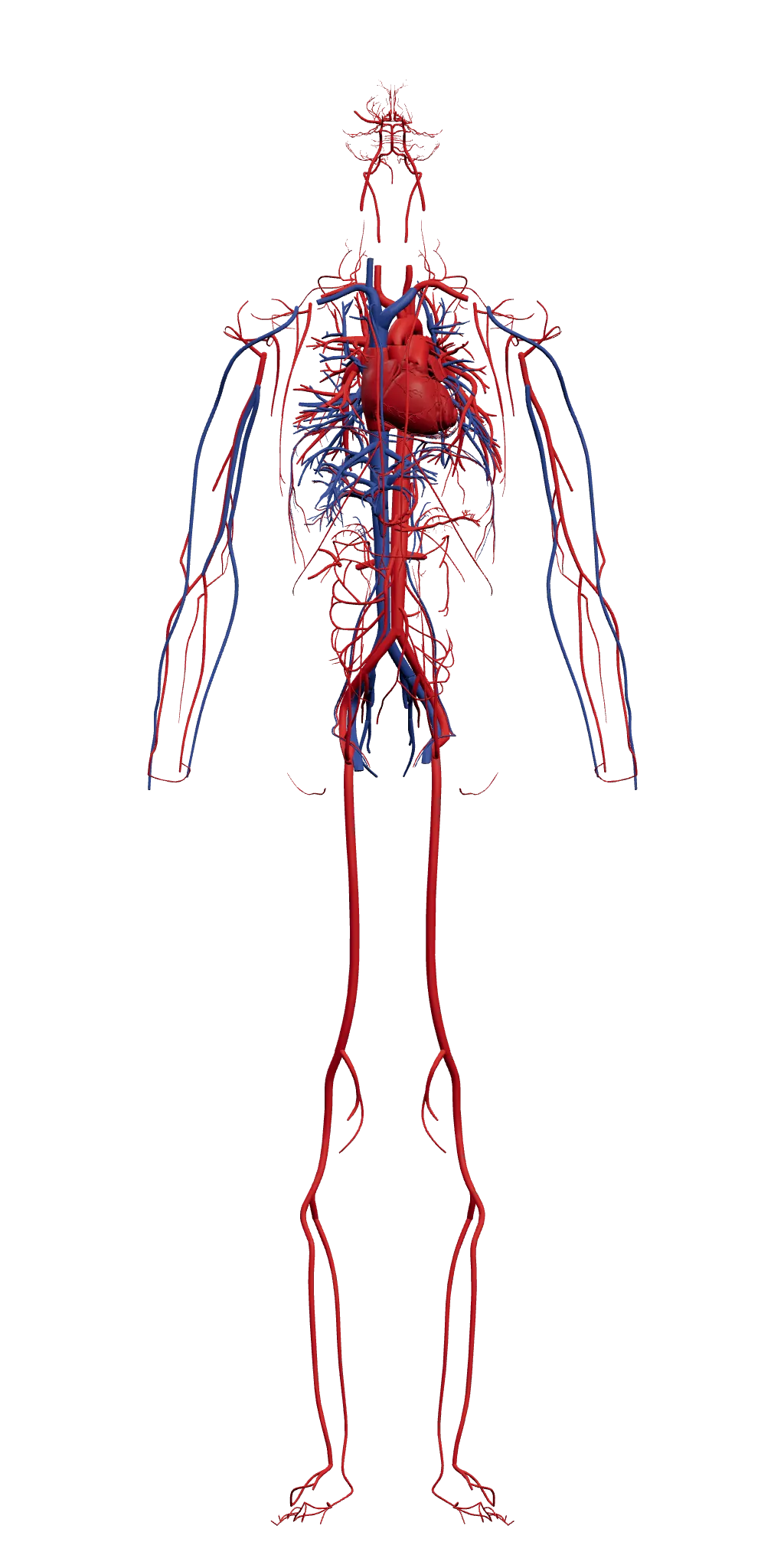
BodyParts3D 4.0: the body, heart and blood vessels
The Database Center for Life Science (DBCLS) · BodyParts3D, in the LSDB Archive
Licence: CC BY 4.0
BodyParts3D, © The Database Center for Life Science licensed under CC Attribution 4.0 International
What we changed: Parts merged into one node per organ (named by its FMA id), decimated to the triangle count given below, smooth normals, millimetres to metres in one body frame shared by every body file (y up, facing forward, the origin on the floor between the feet), quantised and meshopt-compressed GLB. The gonadal vessels end where they leave the abdomen.
The file we serve: circulation.glb, 132,828 triangles in 4 parts, 827 KB.
Close-up files: Close-up files of single organs, loaded only when that organ is named: the same BodyParts3D parts at a finer triangle count. Soft organs cut into segments (the liver, the lungs, the brain, the heart, the gut) are fused into one smooth outer surface, so the cuts between segments do not show. Quantised and meshopt-compressed GLB, most with a lighter copy for phones. Heart (heart.glb, 32,000 triangles, 205 KB; heart-phone.glb, 16,940 triangles, 112 KB) · Aorta (aorta.glb, 10,188 triangles, 63 KB; aorta-phone.glb, 10,188 triangles, 63 KB) · Arteries (arteries.glb, 101,589 triangles, 608 KB) · Veins (veins.glb, 57,875 triangles, 358 KB; veins-phone.glb, 38,557 triangles, 242 KB).
BodyParts3D 4.0: the body, breathing
The Database Center for Life Science (DBCLS); Kristen Browne and Heidi Schlehlein, Human Reference Atlas (HuBMAP) · BodyParts3D, in the LSDB Archive; the Human Reference Atlas 3D Reference Object Library
Licence: CC BY 4.0
BodyParts3D, © The Database Center for Life Science licensed under CC Attribution 4.0 International · Kristen Browne; Heidi Schlehlein. 2023. 3D Reference Organ for Lung, Male v1.3. https://doi.org/10.48539/HBM737.FFBT.876 (CC BY 4.0)
What we changed: Parts merged into one node per organ (named by its FMA id), decimated to the triangle count given below, smooth normals, millimetres to metres in one body frame shared by every body file (y up, facing forward, the origin on the floor between the feet), quantised and meshopt-compressed GLB. The lungs are the atlas lung (its lung segments), scaled and moved into the same body frame so its bronchi meet BodyParts3D's bronchial trees.
The file we serve: breathing.glb, 132,994 triangles in 4 parts, 814 KB.
Close-up files: Close-up files of single organs, loaded only when that organ is named: the same BodyParts3D parts at a finer triangle count. Soft organs cut into segments (the liver, the lungs, the brain, the heart, the gut) are fused into one smooth outer surface, so the cuts between segments do not show. Quantised and meshopt-compressed GLB, most with a lighter copy for phones. Lungs (lungs.glb, 13,998 triangles, 92 KB; lungs-phone.glb, 13,998 triangles, 92 KB).
BodyParts3D 4.0: the body, brain and spinal cord
The Database Center for Life Science (DBCLS) · BodyParts3D, in the LSDB Archive
Licence: CC BY 4.0
BodyParts3D, © The Database Center for Life Science licensed under CC Attribution 4.0 International
What we changed: Parts merged into one node per organ (named by its FMA id), decimated to the triangle count given below, smooth normals, millimetres to metres in one body frame shared by every body file (y up, facing forward, the origin on the floor between the feet), quantised and meshopt-compressed GLB.
The file we serve: nerves.glb, 132,992 triangles in 4 parts, 858 KB.
Close-up files: Close-up files of single organs, loaded only when that organ is named: the same BodyParts3D parts at a finer triangle count. Soft organs cut into segments (the liver, the lungs, the brain, the heart, the gut) are fused into one smooth outer surface, so the cuts between segments do not show. Quantised and meshopt-compressed GLB, most with a lighter copy for phones. Brainstem (brainstem.glb, 32,000 triangles, 192 KB; brainstem-phone.glb, 19,274 triangles, 120 KB) · Cerebellum (cerebellum.glb, 32,000 triangles, 192 KB; cerebellum-phone.glb, 19,612 triangles, 122 KB) · Brain (brain.glb, 96,360 triangles, 612 KB).
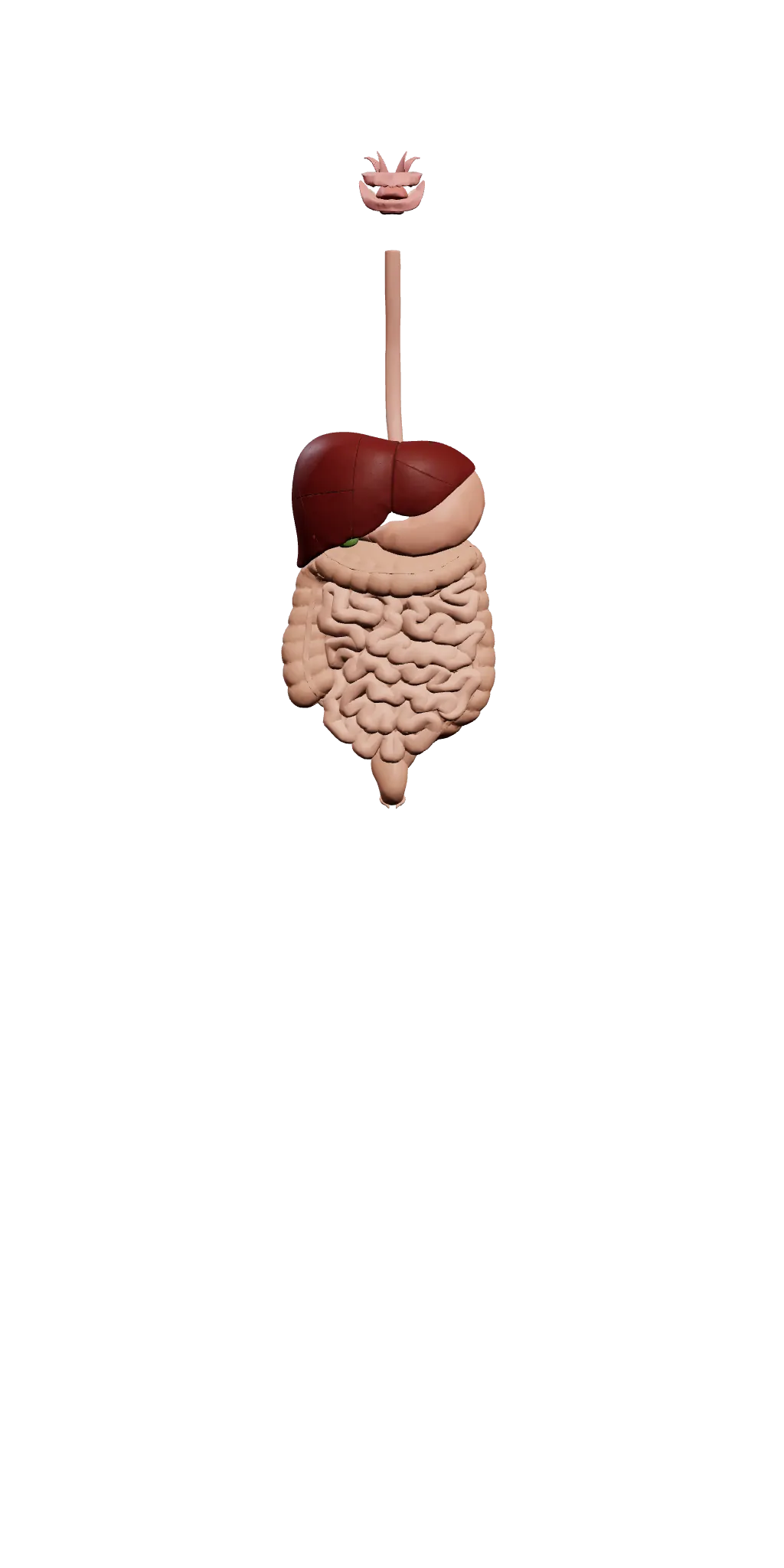
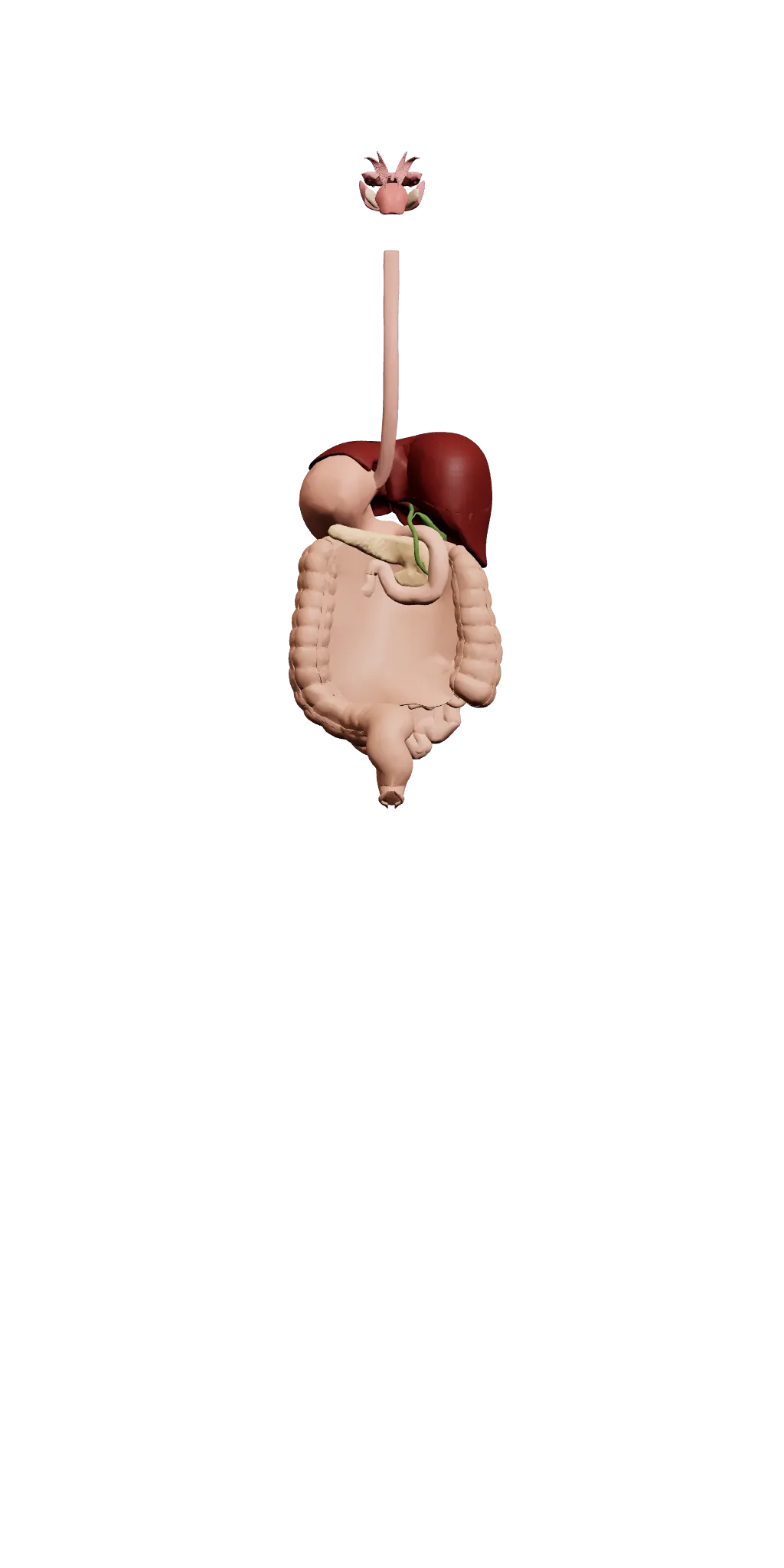
BodyParts3D 4.0: the body, digestion
The Database Center for Life Science (DBCLS) · BodyParts3D, in the LSDB Archive
Licence: CC BY 4.0
BodyParts3D, © The Database Center for Life Science licensed under CC Attribution 4.0 International
What we changed: Parts merged into one node per organ (named by its FMA id), decimated to the triangle count given below, smooth normals, millimetres to metres in one body frame shared by every body file (y up, facing forward, the origin on the floor between the feet), quantised and meshopt-compressed GLB.
The file we serve: digestion.glb, 132,734 triangles in 10 parts, 846 KB.
Close-up files: Close-up files of single organs, loaded only when that organ is named: the same BodyParts3D parts at a finer triangle count. Soft organs cut into segments (the liver, the lungs, the brain, the heart, the gut) are fused into one smooth outer surface, so the cuts between segments do not show. Quantised and meshopt-compressed GLB, most with a lighter copy for phones. Liver (liver.glb, 74,838 triangles, 427 KB; liver-phone.glb, 49,892 triangles, 291 KB) · Gallbladder and bile ducts (gallbladder.glb, 14,470 triangles, 92 KB; gallbladder-phone.glb, 14,470 triangles, 92 KB) · Stomach (stomach.glb, 1,754 triangles, 14 KB; stomach-phone.glb, 1,754 triangles, 14 KB) · Pancreas (pancreas.glb, 16,962 triangles, 104 KB; pancreas-phone.glb, 16,000 triangles, 99 KB) · Small intestine (small-intestine.glb, 31,982 triangles, 205 KB; small-intestine-phone.glb, 21,036 triangles, 136 KB) · Large intestine (large-intestine.glb, 37,072 triangles, 231 KB; large-intestine-phone.glb, 24,716 triangles, 156 KB) · Gums and soft palate (mouth.glb, 33,840 triangles, 216 KB; mouth-phone.glb, 22,560 triangles, 146 KB).
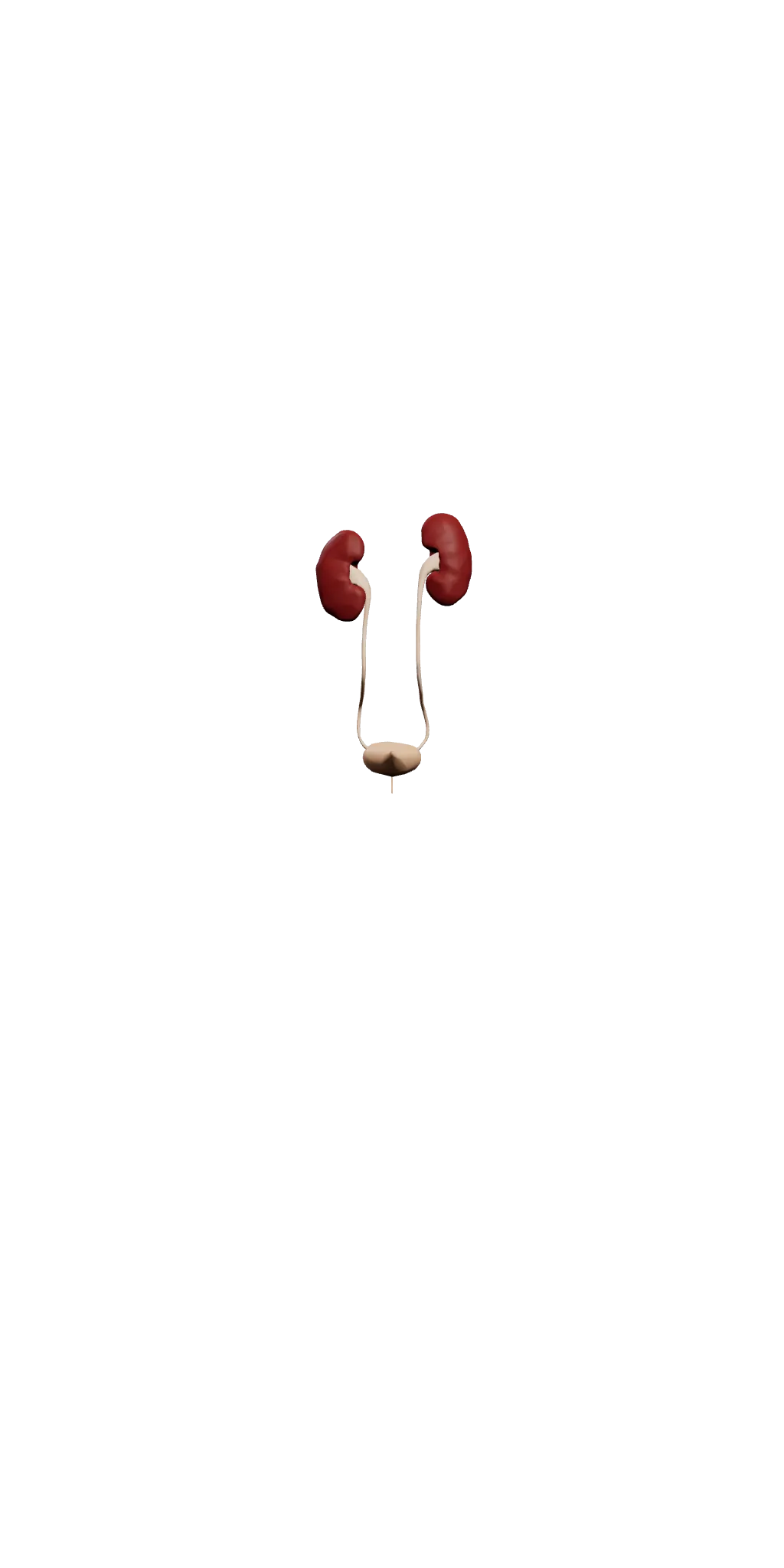
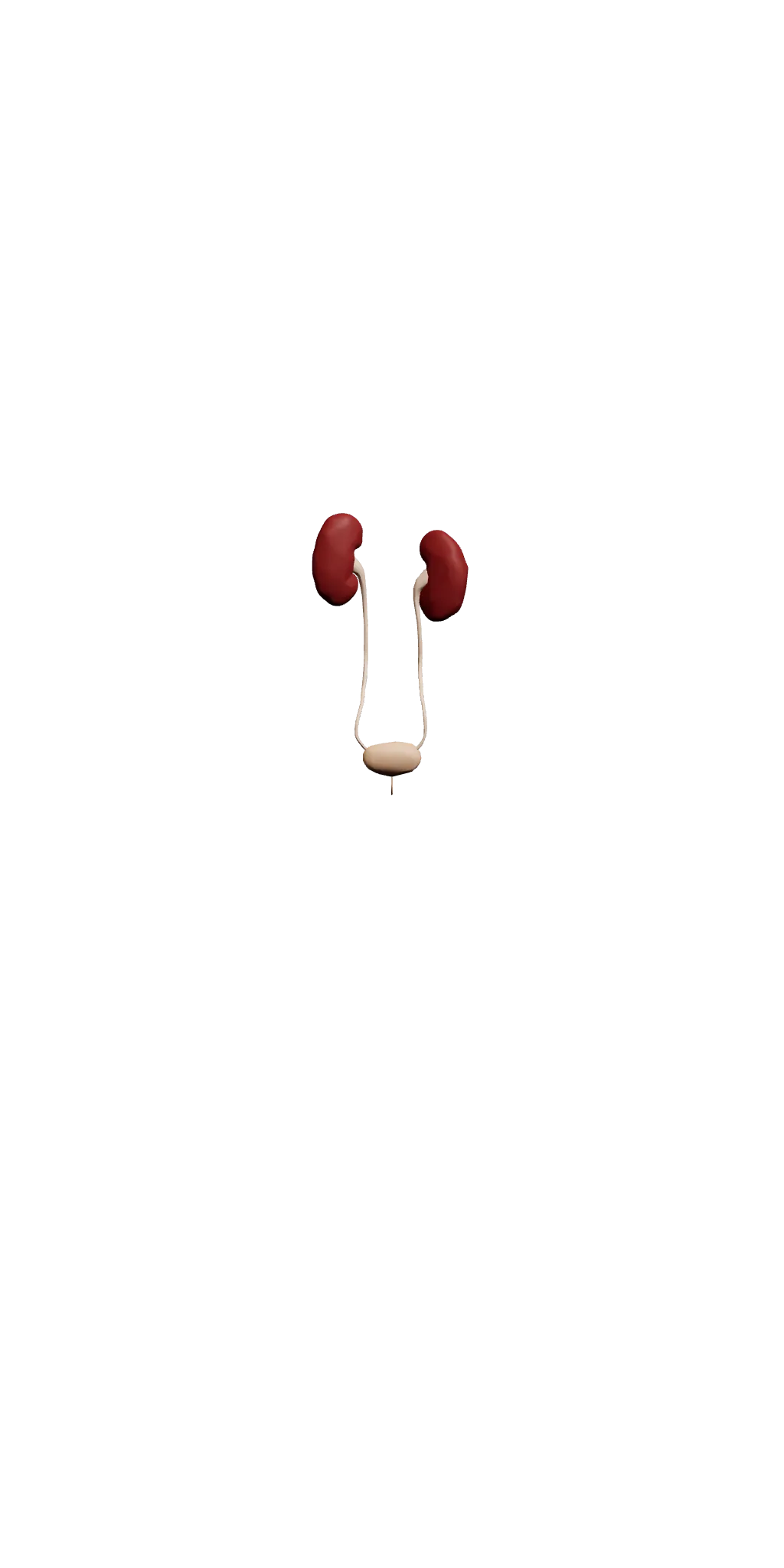
BodyParts3D 4.0: the body, kidneys and bladder
The Database Center for Life Science (DBCLS) · BodyParts3D, in the LSDB Archive
Licence: CC BY 4.0
BodyParts3D, © The Database Center for Life Science licensed under CC Attribution 4.0 International
What we changed: Parts merged into one node per organ (named by its FMA id), decimated to the triangle count given below, smooth normals, millimetres to metres in one body frame shared by every body file (y up, facing forward, the origin on the floor between the feet), quantised and meshopt-compressed GLB. The urethra keeps only its part inside the pelvis.
The file we serve: urinary.glb, 9,647 triangles in 4 parts, 67 KB.
Close-up files: Close-up files of single organs, loaded only when that organ is named: the same BodyParts3D parts at a finer triangle count. Soft organs cut into segments (the liver, the lungs, the brain, the heart, the gut) are fused into one smooth outer surface, so the cuts between segments do not show. Quantised and meshopt-compressed GLB, most with a lighter copy for phones. Kidneys (kidneys.glb, 5,290 triangles, 35 KB; kidneys-phone.glb, 5,290 triangles, 35 KB).
BodyParts3D 4.0: the body, hormones
The Database Center for Life Science (DBCLS) · BodyParts3D, in the LSDB Archive
Licence: CC BY 4.0
BodyParts3D, © The Database Center for Life Science licensed under CC Attribution 4.0 International
What we changed: Parts merged into one node per organ (named by its FMA id), decimated to the triangle count given below, smooth normals, millimetres to metres in one body frame shared by every body file (y up, facing forward, the origin on the floor between the feet), quantised and meshopt-compressed GLB.
The file we serve: hormones.glb, 8,034 triangles in 3 parts, 56 KB.
BodyParts3D 4.0: the body, immunity
The Database Center for Life Science (DBCLS); Kristen Browne, Heidi Schlehlein, Li Yao, Human Reference Atlas (HuBMAP) · BodyParts3D, in the LSDB Archive; the Human Reference Atlas 3D Reference Object Library
Licence: CC BY 4.0
BodyParts3D, © The Database Center for Life Science licensed under CC Attribution 4.0 International · Browne, Kristen, and Heidi Schlehlein. 2024. 3D Reference Organ for Spleen, Male v1.3. https://doi.org/10.48539/HBM437.LMTZ.752. (CC BY 4.0) · Yao, Li, Kristen Browne, and Heidi Schlehlein. 2024. "3D Reference Organ for Lymph Node, Male v1.4." https://doi.org/10.48539/HBM532.TNXR.875. (CC BY 4.0)
What we changed: Parts merged into one node per organ (named by its FMA id), decimated to the triangle count given below, smooth normals, millimetres to metres in one body frame shared by every body file (y up, facing forward, the origin on the floor between the feet), quantised and meshopt-compressed GLB. The spleen from the atlas is moved into the body frame with the atlas lung; its lymph node, a single node, is decimated hard and placed below the left angle of the jaw.
The file we serve: immunity.glb, 17,948 triangles in 3 parts, 124 KB.
BodyParts3D 4.0: the body, reproduction
The Database Center for Life Science (DBCLS); Kristen Browne, Heidi Schlehlein, Human Reference Atlas (HuBMAP) · BodyParts3D, in the LSDB Archive; the Human Reference Atlas 3D Reference Object Library
Licence: CC BY 4.0
BodyParts3D, © The Database Center for Life Science licensed under CC Attribution 4.0 International · Browne, Kristen, and Heidi Schlehlein. 2024. 3D Reference Organ for Uterus v1.1. https://doi.org/10.48539/HBM627.VTKD.892. (CC BY 4.0) · Browne, Kristen, and Heidi Schlehlein. 2024. "3D Reference Organ for Ovary, Female, Left v1.3." https://doi.org/10.48539/HBM695.KCXS.294. (CC BY 4.0) · Browne, Kristen, and Heidi Schlehlein. 2024. "3D Reference Organ for Ovary, Female, Right v1.3." https://doi.org/10.48539/HBM277.TVMB.676. (CC BY 4.0) · Browne, Kristen, and Heidi Schlehlein. 2024. "3D Reference Organ for Fallopian Tube, Female, Left v1.2." https://doi.org/10.48539/HBM529.KBQT.896. (CC BY 4.0) · Browne, Kristen, and Heidi Schlehlein. 2024. "3D Reference Organ for Fallopian Tube, Female, Right v1.2." https://doi.org/10.48539/HBM952.XJJV.857. (CC BY 4.0)
What we changed: Parts merged into one node per organ (named by its FMA id), decimated to the triangle count given below, smooth normals, millimetres to metres in one body frame shared by every body file (y up, facing forward, the origin on the floor between the feet), quantised and meshopt-compressed GLB. Internal organs only: BodyParts3D's prostate, and the atlas's uterus, ovaries and fallopian tubes (from a female body, a separate set placed in the pelvis behind the bladder), so both are taught.
The file we serve: reproduction.glb, 33,232 triangles in 6 parts, 218 KB.
BodyParts3D 4.0: the body, eyes
The Database Center for Life Science (DBCLS) · BodyParts3D, in the LSDB Archive
Licence: CC BY 4.0
BodyParts3D, © The Database Center for Life Science licensed under CC Attribution 4.0 International
What we changed: Parts merged into one node per organ (named by its FMA id), decimated to the triangle count given below, smooth normals, millimetres to metres in one body frame shared by every body file (y up, facing forward, the origin on the floor between the feet), quantised and meshopt-compressed GLB.
The file we serve: eye-ear.glb, 132,986 triangles in 4 parts, 804 KB.
Close-up files: Close-up files of single organs, loaded only when that organ is named: the same BodyParts3D parts at a finer triangle count. Soft organs cut into segments (the liver, the lungs, the brain, the heart, the gut) are fused into one smooth outer surface, so the cuts between segments do not show. Quantised and meshopt-compressed GLB, most with a lighter copy for phones. Eyes (eyes.glb, 102,518 triangles, 610 KB) · Eye muscles (eye-muscles.glb, 34,920 triangles, 219 KB; eye-muscles-phone.glb, 23,280 triangles, 148 KB) · Tear glands and ducts (tear-glands.glb, 6,890 triangles, 45 KB; tear-glands-phone.glb, 6,890 triangles, 45 KB) · Eyelids (eyelids.glb, 5,018 triangles, 33 KB; eyelids-phone.glb, 5,018 triangles, 33 KB).
BodyParts3D 4.0 and the Human Reference Atlas: the whole body, first view
The Database Center for Life Science (DBCLS); Kristen Browne and Heidi Schlehlein, Human Reference Atlas (HuBMAP) · BodyParts3D, in the LSDB Archive; the Human Reference Atlas 3D Reference Object Library
Licence: CC BY 4.0
BodyParts3D, © The Database Center for Life Science licensed under CC Attribution 4.0 International · Kristen Browne; Heidi Schlehlein. 2023. 3D Reference Organ for Lung, Male v1.3. https://doi.org/10.48539/HBM737.FFBT.876 (CC BY 4.0)
What we changed: The neutral skin as a see-through ghost, with light silhouettes of the bones and the main organs (the atlas lung among them), each organ one node named by its FMA id, decimated harder than the organ system files, in the same body frame; quantised and meshopt-compressed GLB.
The file we serve: body-first.glb, 148,451 triangles in 28 parts, 996 KB.
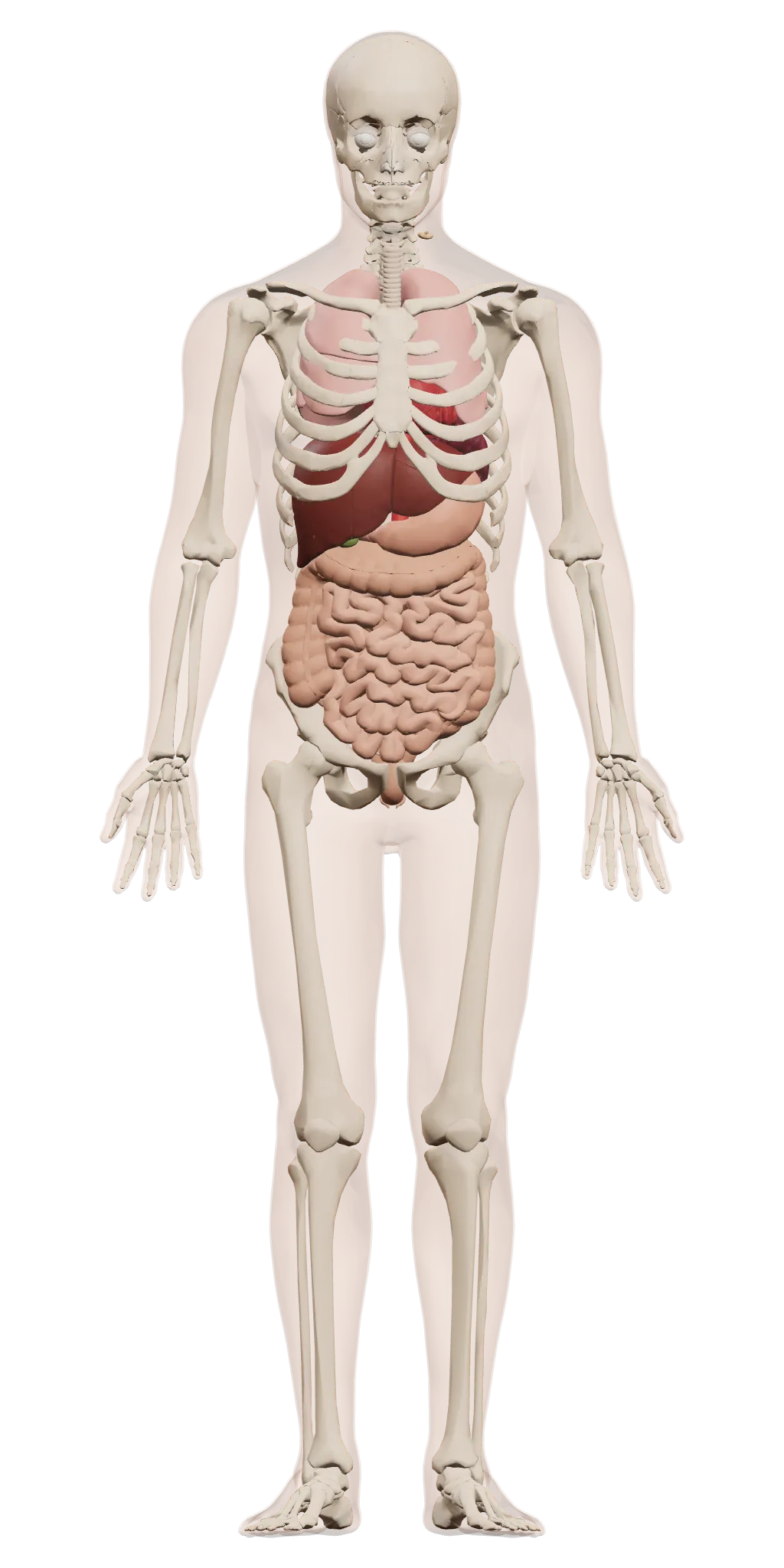
The body from the front: a 2D plate
The Database Center for Life Science (DBCLS); Kristen Browne, Heidi Schlehlein and Li Yao, Human Reference Atlas (HuBMAP) · BodyParts3D, in the LSDB Archive; the Human Reference Atlas 3D Reference Object Library
Licence: CC BY 4.0
BodyParts3D, © The Database Center for Life Science licensed under CC Attribution 4.0 International · Kristen Browne; Heidi Schlehlein. 2023. 3D Reference Organ for Lung, Male v1.3. https://doi.org/10.48539/HBM737.FFBT.876 (CC BY 4.0) · Browne, Kristen, and Heidi Schlehlein. 2024. 3D Reference Organ for Spleen, Male v1.3. https://doi.org/10.48539/HBM437.LMTZ.752. (CC BY 4.0) · Yao, Li, Kristen Browne, and Heidi Schlehlein. 2024. "3D Reference Organ for Lymph Node, Male v1.4." https://doi.org/10.48539/HBM532.TNXR.875. (CC BY 4.0)
What we changed: Rendered from the body files on this page (the bones and organs in their tissue colours under the neutral skin as a ghost), seen straight from the front, as a WebP with a transparent background.
The file we serve: plate-front.webp, 1024 x 2048 pixels, 96 KB.
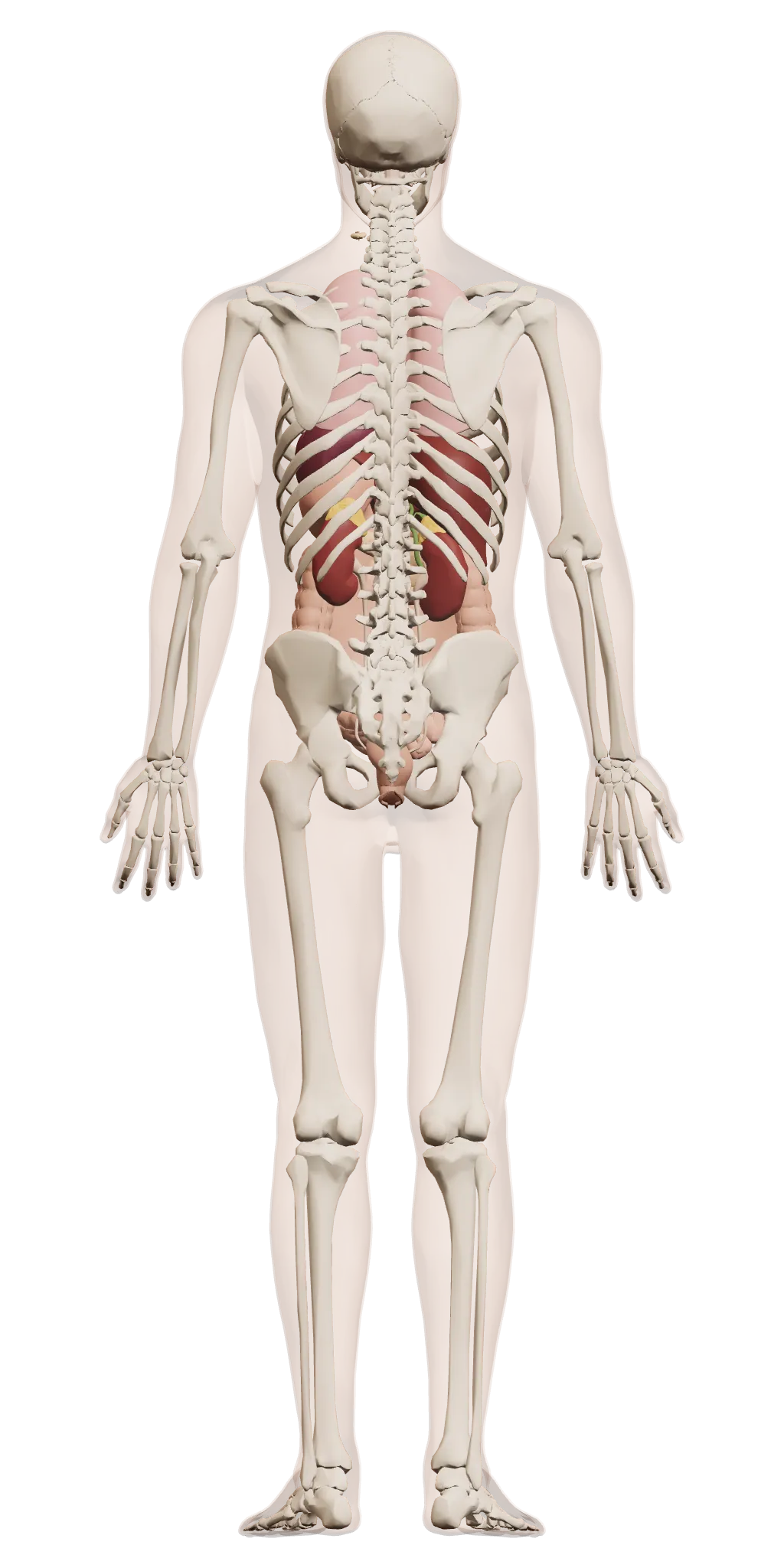
The body from the back: a 2D plate
The Database Center for Life Science (DBCLS); Kristen Browne, Heidi Schlehlein and Li Yao, Human Reference Atlas (HuBMAP) · BodyParts3D, in the LSDB Archive; the Human Reference Atlas 3D Reference Object Library
Licence: CC BY 4.0
BodyParts3D, © The Database Center for Life Science licensed under CC Attribution 4.0 International · Kristen Browne; Heidi Schlehlein. 2023. 3D Reference Organ for Lung, Male v1.3. https://doi.org/10.48539/HBM737.FFBT.876 (CC BY 4.0) · Browne, Kristen, and Heidi Schlehlein. 2024. 3D Reference Organ for Spleen, Male v1.3. https://doi.org/10.48539/HBM437.LMTZ.752. (CC BY 4.0) · Yao, Li, Kristen Browne, and Heidi Schlehlein. 2024. "3D Reference Organ for Lymph Node, Male v1.4." https://doi.org/10.48539/HBM532.TNXR.875. (CC BY 4.0)
What we changed: Rendered from the body files on this page (the bones and organs in their tissue colours under the neutral skin as a ghost), seen straight from the back, as a WebP with a transparent background.
The file we serve: plate-back.webp, 1024 x 2048 pixels, 102 KB.
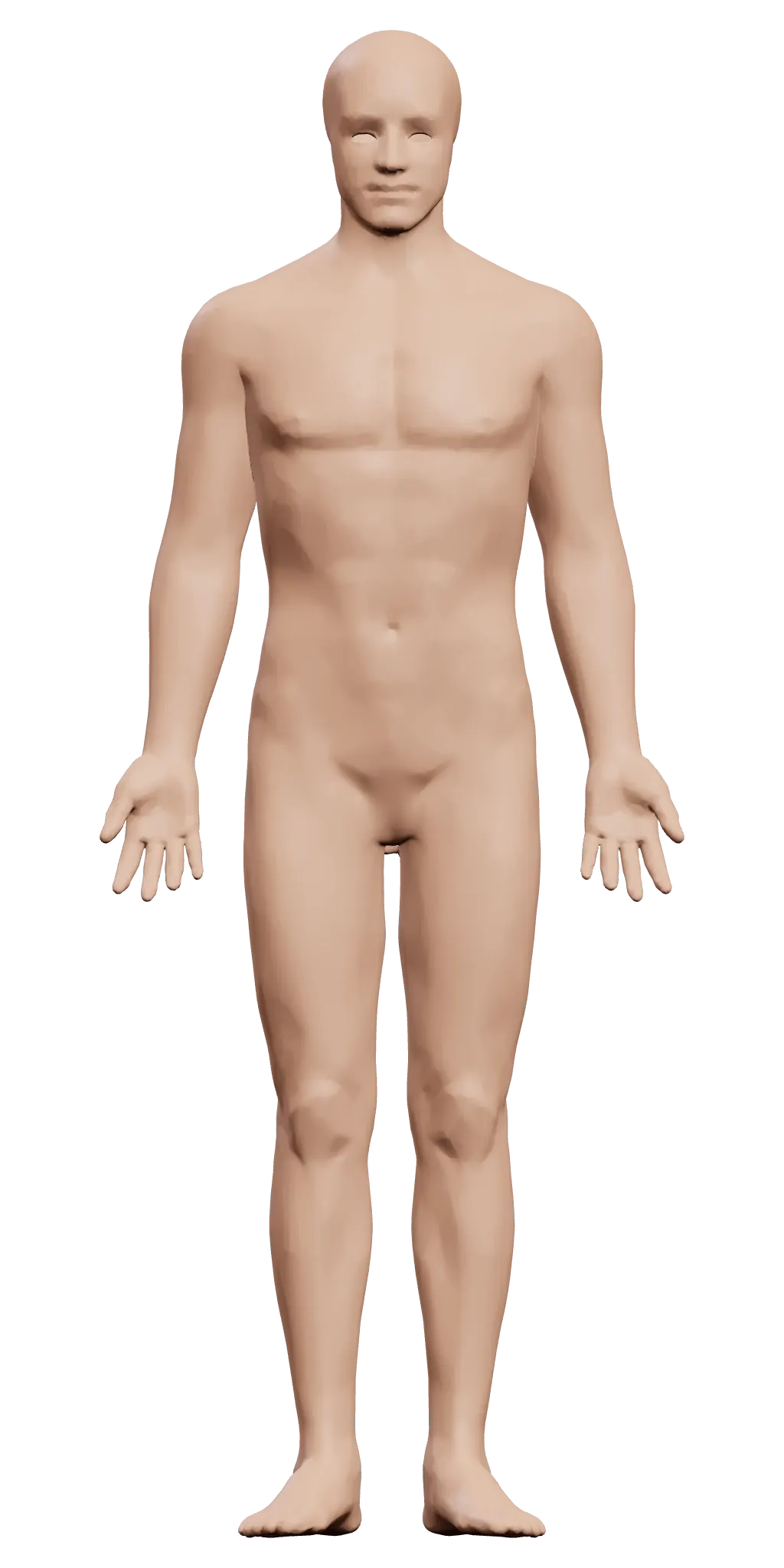
Skin from the front: a 2D plate
The Database Center for Life Science (DBCLS) · BodyParts3D, in the LSDB Archive
Licence: CC BY 4.0
BodyParts3D, © The Database Center for Life Science licensed under CC Attribution 4.0 International
What we changed: Rendered from skin.glb on this page, alone, in its tissue colours, seen straight from the front in the same view as the whole-body plates, as a WebP with a transparent background; the 2D body lays it over the whole body when the system is lit.
The file we serve: plate-skin-front.webp, 1024 x 2048 pixels, 33 KB.
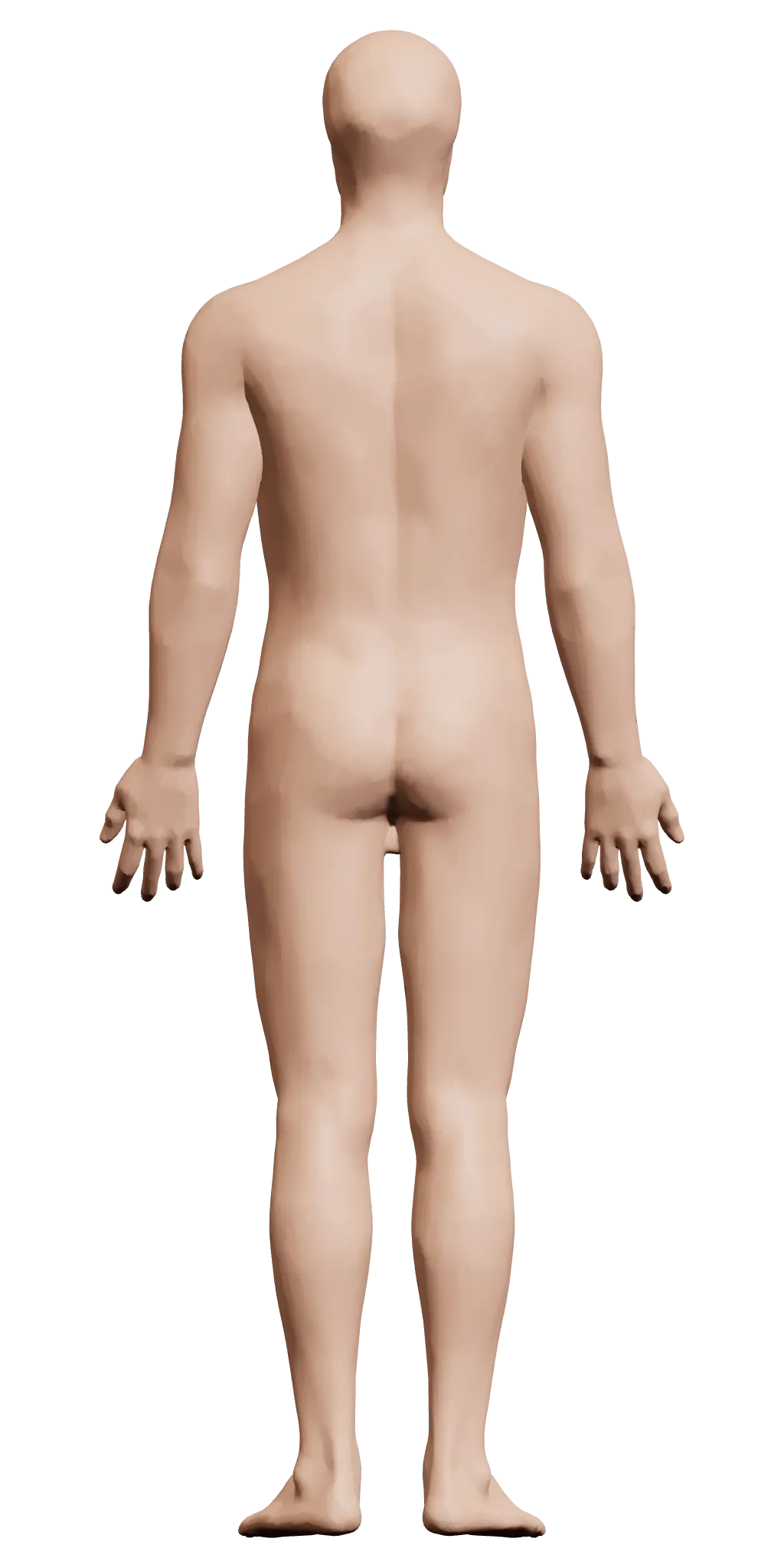
Skin from the back: a 2D plate
The Database Center for Life Science (DBCLS) · BodyParts3D, in the LSDB Archive
Licence: CC BY 4.0
BodyParts3D, © The Database Center for Life Science licensed under CC Attribution 4.0 International
What we changed: Rendered from skin.glb on this page, alone, in its tissue colours, seen straight from the back in the same view as the whole-body plates, as a WebP with a transparent background; the 2D body lays it over the whole body when the system is lit.
The file we serve: plate-skin-back.webp, 1024 x 2048 pixels, 31 KB.
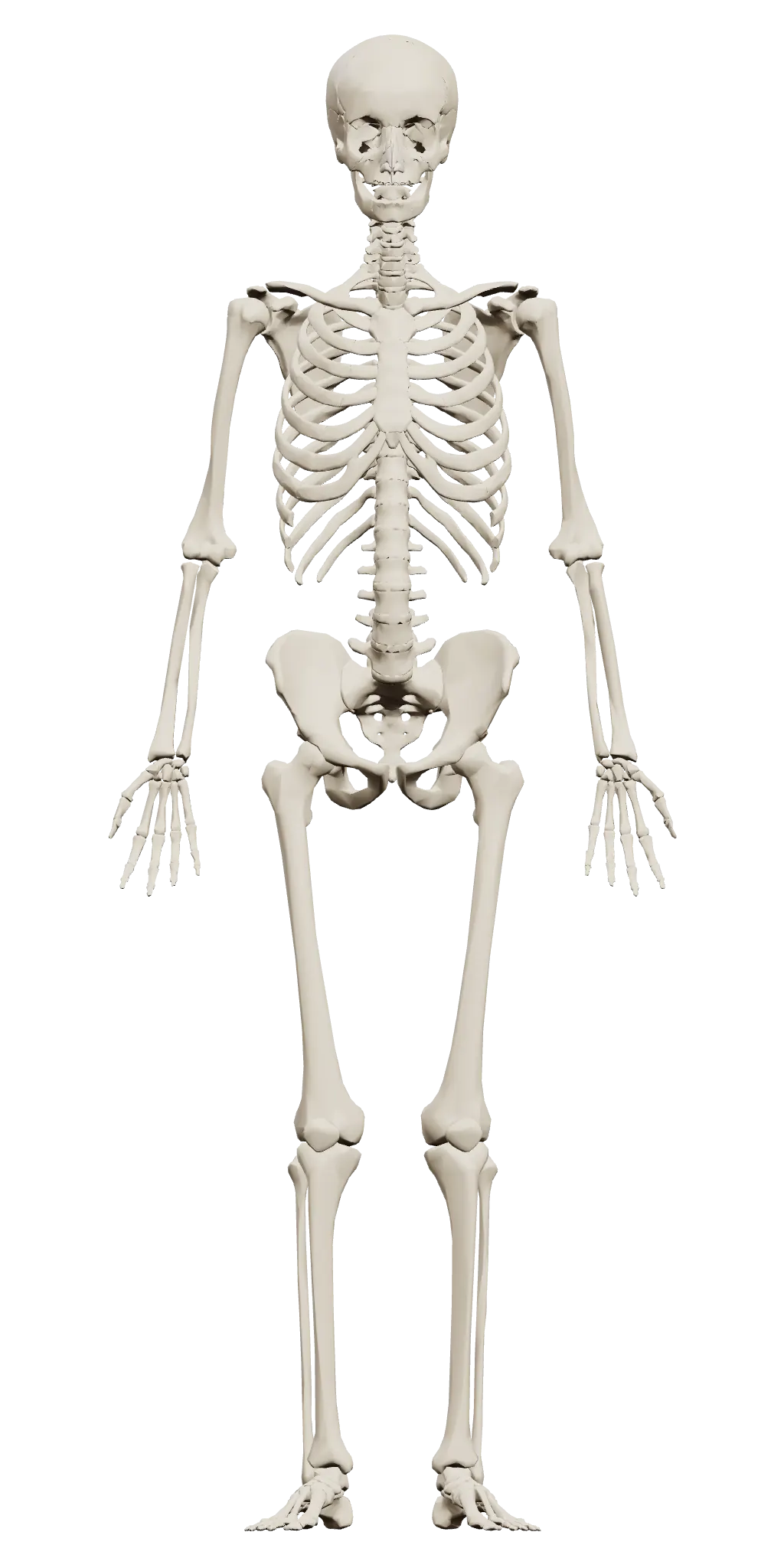
Skeleton from the front: a 2D plate
The Database Center for Life Science (DBCLS) · BodyParts3D, in the LSDB Archive
Licence: CC BY 4.0
BodyParts3D, © The Database Center for Life Science licensed under CC Attribution 4.0 International
What we changed: Rendered from skeleton.glb on this page, alone, in its tissue colours, seen straight from the front in the same view as the whole-body plates, as a WebP with a transparent background; the 2D body lays it over the whole body when the system is lit.
The file we serve: plate-skeleton-front.webp, 1024 x 2048 pixels, 65 KB.
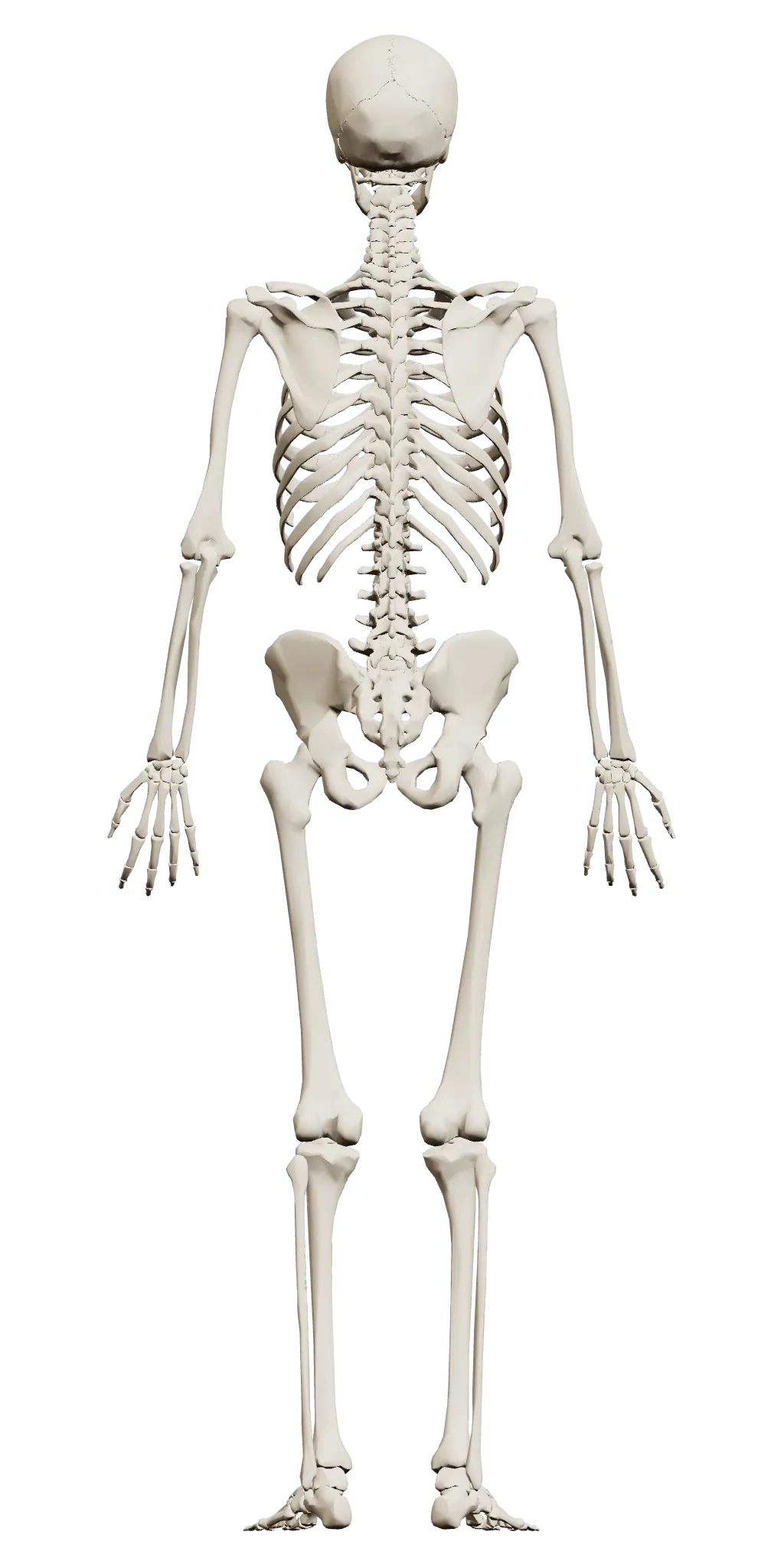
Skeleton from the back: a 2D plate
The Database Center for Life Science (DBCLS) · BodyParts3D, in the LSDB Archive
Licence: CC BY 4.0
BodyParts3D, © The Database Center for Life Science licensed under CC Attribution 4.0 International
What we changed: Rendered from skeleton.glb on this page, alone, in its tissue colours, seen straight from the back in the same view as the whole-body plates, as a WebP with a transparent background; the 2D body lays it over the whole body when the system is lit.
The file we serve: plate-skeleton-back.webp, 1024 x 2048 pixels, 69 KB.
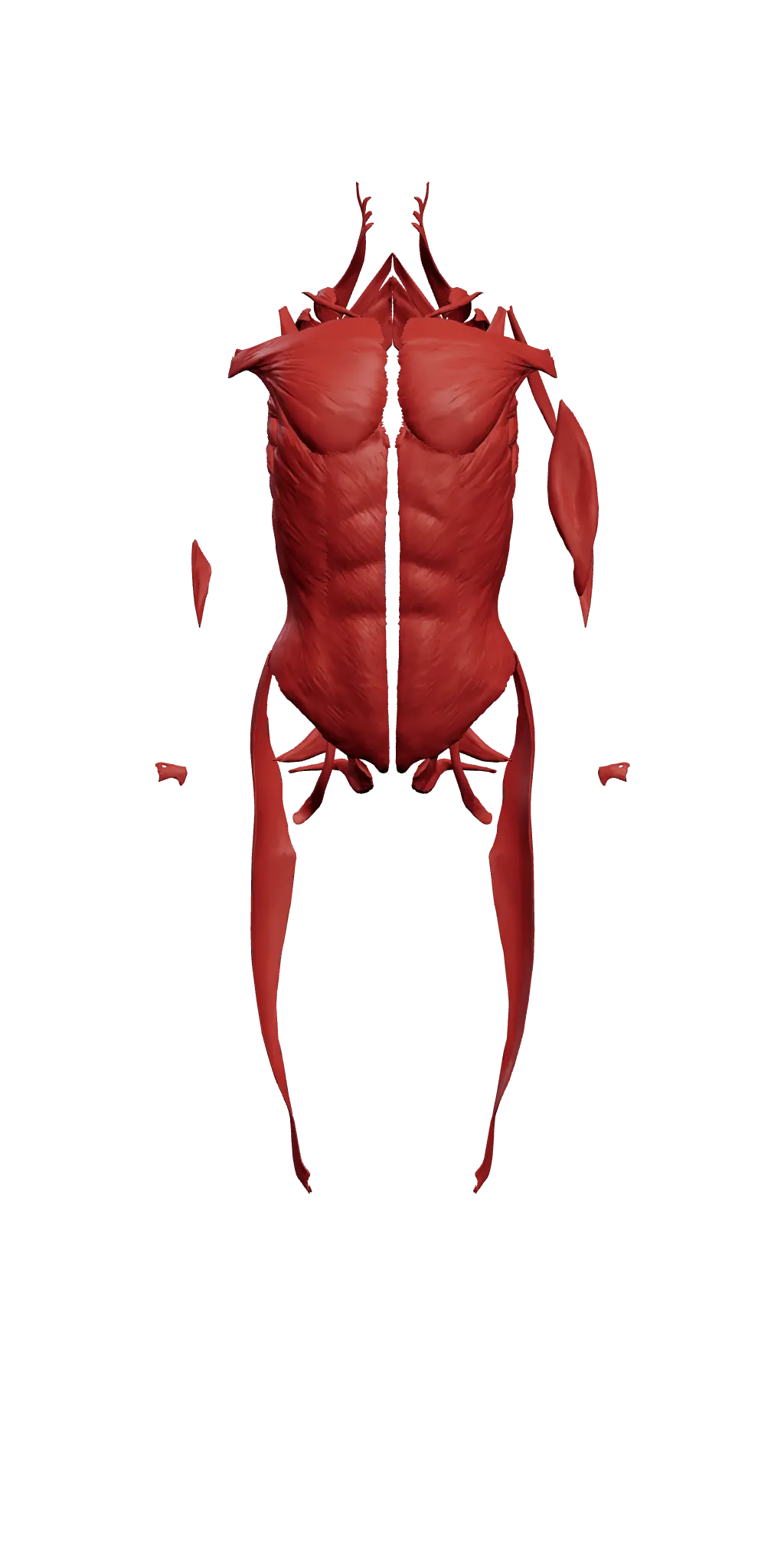
Muscles from the front: a 2D plate
The Database Center for Life Science (DBCLS) · BodyParts3D, in the LSDB Archive
Licence: CC BY 4.0
BodyParts3D, © The Database Center for Life Science licensed under CC Attribution 4.0 International
What we changed: Rendered from muscles.glb on this page, alone, in its tissue colours, seen straight from the front in the same view as the whole-body plates, as a WebP with a transparent background; the 2D body lays it over the whole body when the system is lit.
The file we serve: plate-muscles-front.webp, 1024 x 2048 pixels, 38 KB.
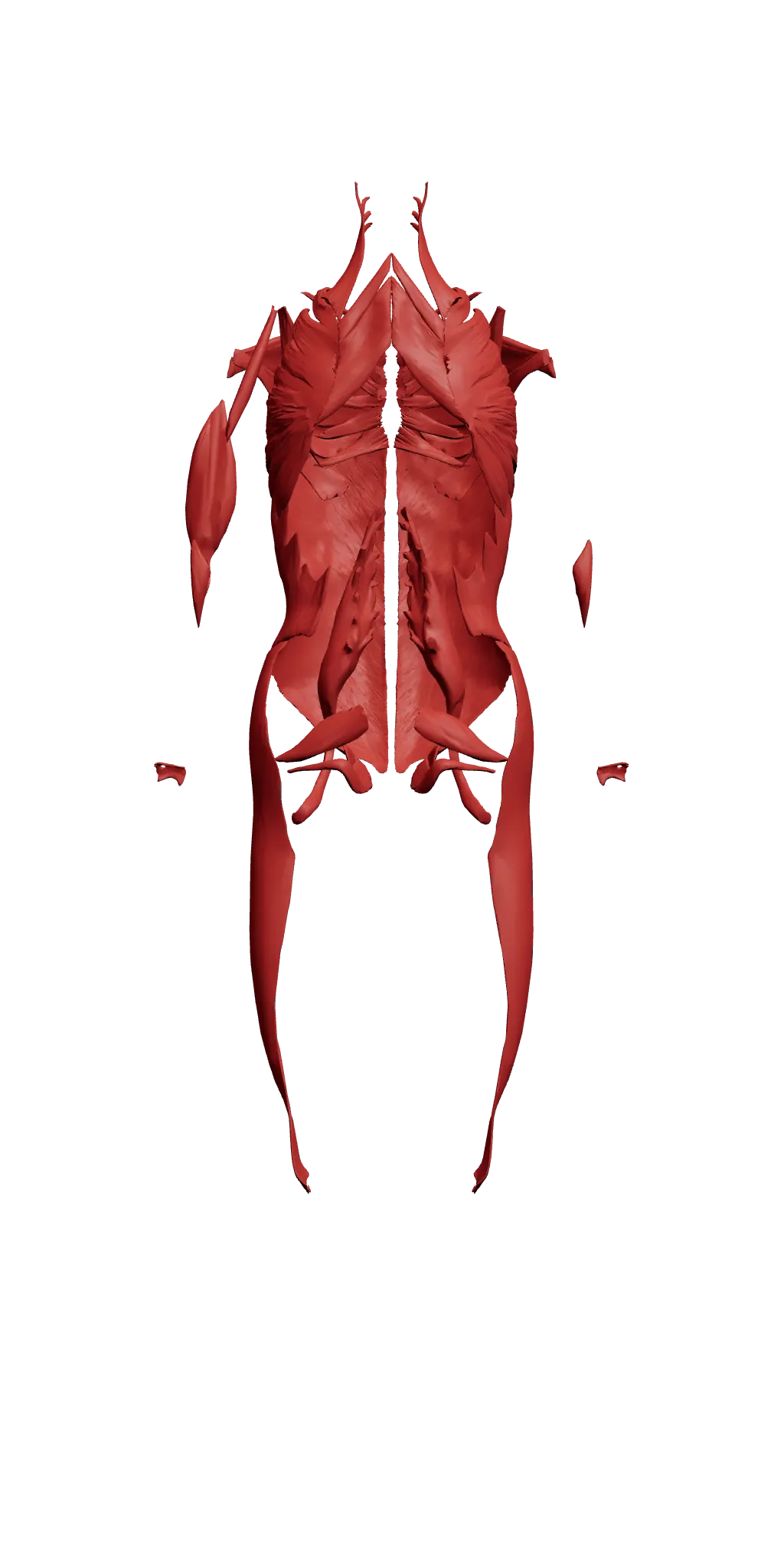
Muscles from the back: a 2D plate
The Database Center for Life Science (DBCLS) · BodyParts3D, in the LSDB Archive
Licence: CC BY 4.0
BodyParts3D, © The Database Center for Life Science licensed under CC Attribution 4.0 International
What we changed: Rendered from muscles.glb on this page, alone, in its tissue colours, seen straight from the back in the same view as the whole-body plates, as a WebP with a transparent background; the 2D body lays it over the whole body when the system is lit.
The file we serve: plate-muscles-back.webp, 1024 x 2048 pixels, 43 KB.
Heart and blood vessels from the front: a 2D plate
The Database Center for Life Science (DBCLS) · BodyParts3D, in the LSDB Archive
Licence: CC BY 4.0
BodyParts3D, © The Database Center for Life Science licensed under CC Attribution 4.0 International
What we changed: Rendered from circulation.glb on this page, alone, in its tissue colours, seen straight from the front in the same view as the whole-body plates, as a WebP with a transparent background; the 2D body lays it over the whole body when the system is lit.
The file we serve: plate-circulation-front.webp, 1024 x 2048 pixels, 97 KB.
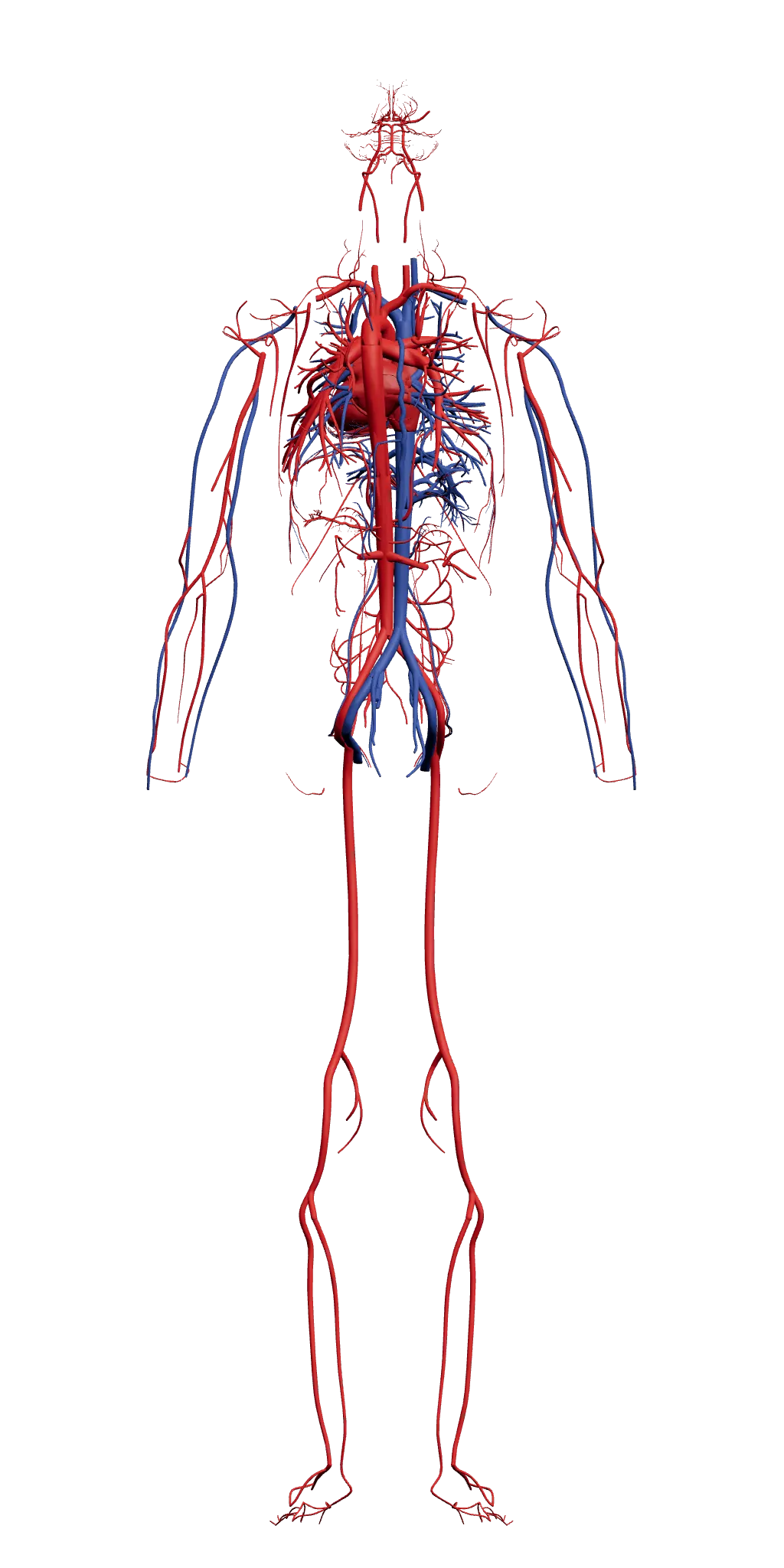
Heart and blood vessels from the back: a 2D plate
The Database Center for Life Science (DBCLS) · BodyParts3D, in the LSDB Archive
Licence: CC BY 4.0
BodyParts3D, © The Database Center for Life Science licensed under CC Attribution 4.0 International
What we changed: Rendered from circulation.glb on this page, alone, in its tissue colours, seen straight from the back in the same view as the whole-body plates, as a WebP with a transparent background; the 2D body lays it over the whole body when the system is lit.
The file we serve: plate-circulation-back.webp, 1024 x 2048 pixels, 102 KB.
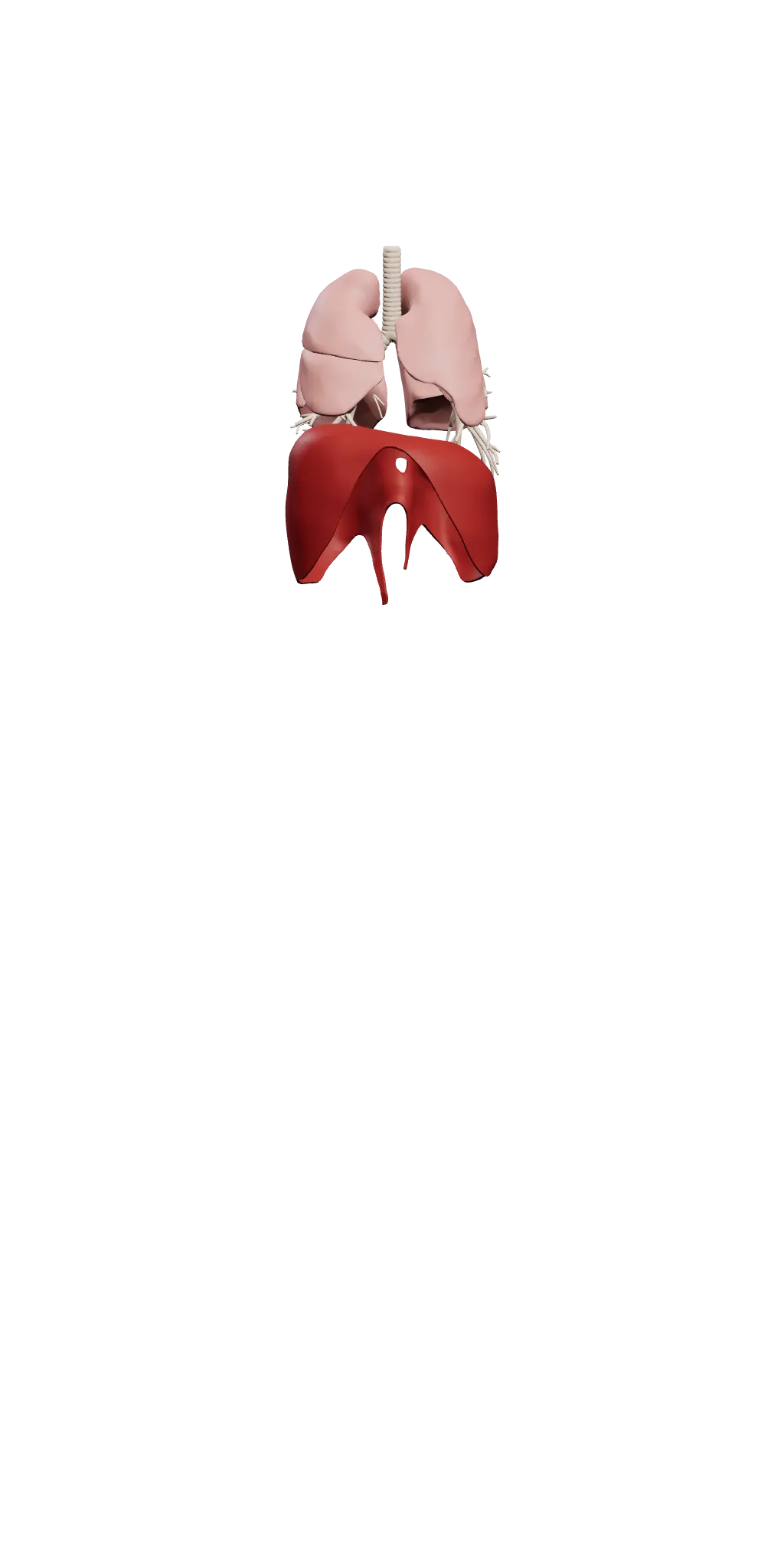
Breathing from the front: a 2D plate
The Database Center for Life Science (DBCLS); Kristen Browne and Heidi Schlehlein, Human Reference Atlas (HuBMAP) · BodyParts3D, in the LSDB Archive; the Human Reference Atlas 3D Reference Object Library
Licence: CC BY 4.0
BodyParts3D, © The Database Center for Life Science licensed under CC Attribution 4.0 International · Kristen Browne; Heidi Schlehlein. 2023. 3D Reference Organ for Lung, Male v1.3. https://doi.org/10.48539/HBM737.FFBT.876 (CC BY 4.0)
What we changed: Rendered from breathing.glb on this page, alone, in its tissue colours, seen straight from the front in the same view as the whole-body plates, as a WebP with a transparent background; the 2D body lays it over the whole body when the system is lit.
The file we serve: plate-breathing-front.webp, 1024 x 2048 pixels, 15 KB.
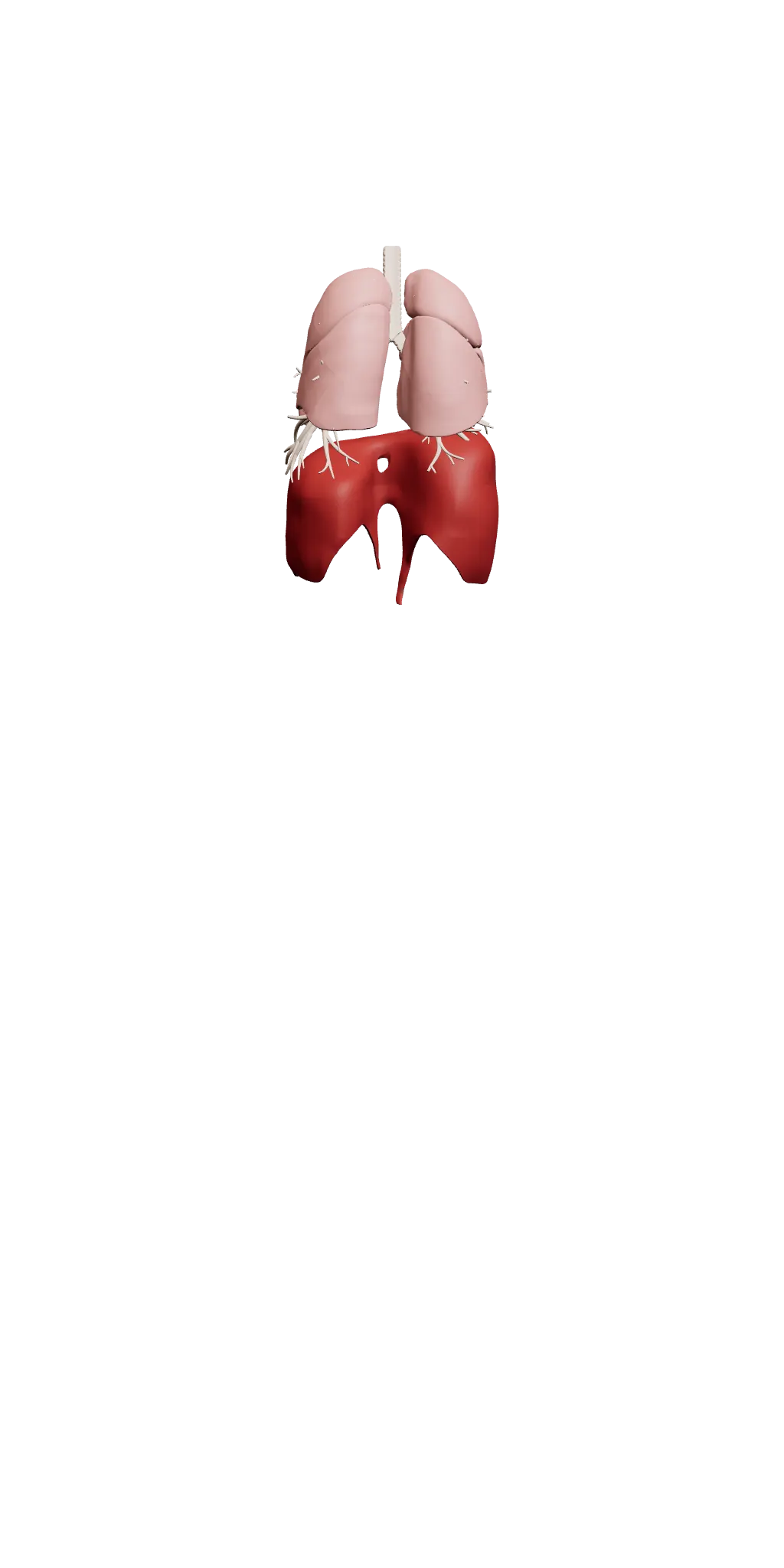
Breathing from the back: a 2D plate
The Database Center for Life Science (DBCLS); Kristen Browne and Heidi Schlehlein, Human Reference Atlas (HuBMAP) · BodyParts3D, in the LSDB Archive; the Human Reference Atlas 3D Reference Object Library
Licence: CC BY 4.0
BodyParts3D, © The Database Center for Life Science licensed under CC Attribution 4.0 International · Kristen Browne; Heidi Schlehlein. 2023. 3D Reference Organ for Lung, Male v1.3. https://doi.org/10.48539/HBM737.FFBT.876 (CC BY 4.0)
What we changed: Rendered from breathing.glb on this page, alone, in its tissue colours, seen straight from the back in the same view as the whole-body plates, as a WebP with a transparent background; the 2D body lays it over the whole body when the system is lit.
The file we serve: plate-breathing-back.webp, 1024 x 2048 pixels, 15 KB.
Brain and spinal cord from the front: a 2D plate
The Database Center for Life Science (DBCLS) · BodyParts3D, in the LSDB Archive
Licence: CC BY 4.0
BodyParts3D, © The Database Center for Life Science licensed under CC Attribution 4.0 International
What we changed: Rendered from nerves.glb on this page, alone, in its tissue colours, seen straight from the front in the same view as the whole-body plates, as a WebP with a transparent background; the 2D body lays it over the whole body when the system is lit.
The file we serve: plate-nerves-front.webp, 1024 x 2048 pixels, 9 KB.
Brain and spinal cord from the back: a 2D plate
The Database Center for Life Science (DBCLS) · BodyParts3D, in the LSDB Archive
Licence: CC BY 4.0
BodyParts3D, © The Database Center for Life Science licensed under CC Attribution 4.0 International
What we changed: Rendered from nerves.glb on this page, alone, in its tissue colours, seen straight from the back in the same view as the whole-body plates, as a WebP with a transparent background; the 2D body lays it over the whole body when the system is lit.
The file we serve: plate-nerves-back.webp, 1024 x 2048 pixels, 8 KB.
Digestion from the front: a 2D plate
The Database Center for Life Science (DBCLS) · BodyParts3D, in the LSDB Archive
Licence: CC BY 4.0
BodyParts3D, © The Database Center for Life Science licensed under CC Attribution 4.0 International
What we changed: Rendered from digestion.glb on this page, alone, in its tissue colours, seen straight from the front in the same view as the whole-body plates, as a WebP with a transparent background; the 2D body lays it over the whole body when the system is lit.
The file we serve: plate-digestion-front.webp, 1024 x 2048 pixels, 19 KB.
Digestion from the back: a 2D plate
The Database Center for Life Science (DBCLS) · BodyParts3D, in the LSDB Archive
Licence: CC BY 4.0
BodyParts3D, © The Database Center for Life Science licensed under CC Attribution 4.0 International
What we changed: Rendered from digestion.glb on this page, alone, in its tissue colours, seen straight from the back in the same view as the whole-body plates, as a WebP with a transparent background; the 2D body lays it over the whole body when the system is lit.
The file we serve: plate-digestion-back.webp, 1024 x 2048 pixels, 17 KB.
Kidneys and bladder from the front: a 2D plate
The Database Center for Life Science (DBCLS) · BodyParts3D, in the LSDB Archive
Licence: CC BY 4.0
BodyParts3D, © The Database Center for Life Science licensed under CC Attribution 4.0 International
What we changed: Rendered from urinary.glb on this page, alone, in its tissue colours, seen straight from the front in the same view as the whole-body plates, as a WebP with a transparent background; the 2D body lays it over the whole body when the system is lit.
The file we serve: plate-urinary-front.webp, 1024 x 2048 pixels, 8 KB.
Kidneys and bladder from the back: a 2D plate
The Database Center for Life Science (DBCLS) · BodyParts3D, in the LSDB Archive
Licence: CC BY 4.0
BodyParts3D, © The Database Center for Life Science licensed under CC Attribution 4.0 International
What we changed: Rendered from urinary.glb on this page, alone, in its tissue colours, seen straight from the back in the same view as the whole-body plates, as a WebP with a transparent background; the 2D body lays it over the whole body when the system is lit.
The file we serve: plate-urinary-back.webp, 1024 x 2048 pixels, 8 KB.
Hormones from the front: a 2D plate
The Database Center for Life Science (DBCLS) · BodyParts3D, in the LSDB Archive
Licence: CC BY 4.0
BodyParts3D, © The Database Center for Life Science licensed under CC Attribution 4.0 International
What we changed: Rendered from hormones.glb on this page, alone, in its tissue colours, seen straight from the front in the same view as the whole-body plates, as a WebP with a transparent background; the 2D body lays it over the whole body when the system is lit.
The file we serve: plate-hormones-front.webp, 1024 x 2048 pixels, 6 KB.
Hormones from the back: a 2D plate
The Database Center for Life Science (DBCLS) · BodyParts3D, in the LSDB Archive
Licence: CC BY 4.0
BodyParts3D, © The Database Center for Life Science licensed under CC Attribution 4.0 International
What we changed: Rendered from hormones.glb on this page, alone, in its tissue colours, seen straight from the back in the same view as the whole-body plates, as a WebP with a transparent background; the 2D body lays it over the whole body when the system is lit.
The file we serve: plate-hormones-back.webp, 1024 x 2048 pixels, 6 KB.
Immunity from the front: a 2D plate
The Database Center for Life Science (DBCLS); Kristen Browne, Heidi Schlehlein, Li Yao, Human Reference Atlas (HuBMAP) · BodyParts3D, in the LSDB Archive; the Human Reference Atlas 3D Reference Object Library
Licence: CC BY 4.0
BodyParts3D, © The Database Center for Life Science licensed under CC Attribution 4.0 International · Browne, Kristen, and Heidi Schlehlein. 2024. 3D Reference Organ for Spleen, Male v1.3. https://doi.org/10.48539/HBM437.LMTZ.752. (CC BY 4.0) · Yao, Li, Kristen Browne, and Heidi Schlehlein. 2024. "3D Reference Organ for Lymph Node, Male v1.4." https://doi.org/10.48539/HBM532.TNXR.875. (CC BY 4.0)
What we changed: Rendered from immunity.glb on this page, alone, in its tissue colours, seen straight from the front in the same view as the whole-body plates, as a WebP with a transparent background; the 2D body lays it over the whole body when the system is lit.
The file we serve: plate-immunity-front.webp, 1024 x 2048 pixels, 6 KB.
Immunity from the back: a 2D plate
The Database Center for Life Science (DBCLS); Kristen Browne, Heidi Schlehlein, Li Yao, Human Reference Atlas (HuBMAP) · BodyParts3D, in the LSDB Archive; the Human Reference Atlas 3D Reference Object Library
Licence: CC BY 4.0
BodyParts3D, © The Database Center for Life Science licensed under CC Attribution 4.0 International · Browne, Kristen, and Heidi Schlehlein. 2024. 3D Reference Organ for Spleen, Male v1.3. https://doi.org/10.48539/HBM437.LMTZ.752. (CC BY 4.0) · Yao, Li, Kristen Browne, and Heidi Schlehlein. 2024. "3D Reference Organ for Lymph Node, Male v1.4." https://doi.org/10.48539/HBM532.TNXR.875. (CC BY 4.0)
What we changed: Rendered from immunity.glb on this page, alone, in its tissue colours, seen straight from the back in the same view as the whole-body plates, as a WebP with a transparent background; the 2D body lays it over the whole body when the system is lit.
The file we serve: plate-immunity-back.webp, 1024 x 2048 pixels, 6 KB.
Reproduction, the female organs from the front: a 2D plate
The Database Center for Life Science (DBCLS); Kristen Browne, Heidi Schlehlein, Human Reference Atlas (HuBMAP) · BodyParts3D, in the LSDB Archive; the Human Reference Atlas 3D Reference Object Library
Licence: CC BY 4.0
BodyParts3D, © The Database Center for Life Science licensed under CC Attribution 4.0 International · Browne, Kristen, and Heidi Schlehlein. 2024. 3D Reference Organ for Uterus v1.1. https://doi.org/10.48539/HBM627.VTKD.892. (CC BY 4.0) · Browne, Kristen, and Heidi Schlehlein. 2024. "3D Reference Organ for Ovary, Female, Left v1.3." https://doi.org/10.48539/HBM695.KCXS.294. (CC BY 4.0) · Browne, Kristen, and Heidi Schlehlein. 2024. "3D Reference Organ for Ovary, Female, Right v1.3." https://doi.org/10.48539/HBM277.TVMB.676. (CC BY 4.0) · Browne, Kristen, and Heidi Schlehlein. 2024. "3D Reference Organ for Fallopian Tube, Female, Left v1.2." https://doi.org/10.48539/HBM529.KBQT.896. (CC BY 4.0) · Browne, Kristen, and Heidi Schlehlein. 2024. "3D Reference Organ for Fallopian Tube, Female, Right v1.2." https://doi.org/10.48539/HBM952.XJJV.857. (CC BY 4.0)
What we changed: Rendered from reproduction.glb on this page, the female organs, alone, in its tissue colours, seen straight from the front in the same view as the whole-body plates, as a WebP with a transparent background; the 2D body lays it over the whole body when the system is lit.
The file we serve: plate-reproduction-female-front.webp, 1024 x 2048 pixels, 6 KB.
Reproduction, the female organs from the back: a 2D plate
The Database Center for Life Science (DBCLS); Kristen Browne, Heidi Schlehlein, Human Reference Atlas (HuBMAP) · BodyParts3D, in the LSDB Archive; the Human Reference Atlas 3D Reference Object Library
Licence: CC BY 4.0
BodyParts3D, © The Database Center for Life Science licensed under CC Attribution 4.0 International · Browne, Kristen, and Heidi Schlehlein. 2024. 3D Reference Organ for Uterus v1.1. https://doi.org/10.48539/HBM627.VTKD.892. (CC BY 4.0) · Browne, Kristen, and Heidi Schlehlein. 2024. "3D Reference Organ for Ovary, Female, Left v1.3." https://doi.org/10.48539/HBM695.KCXS.294. (CC BY 4.0) · Browne, Kristen, and Heidi Schlehlein. 2024. "3D Reference Organ for Ovary, Female, Right v1.3." https://doi.org/10.48539/HBM277.TVMB.676. (CC BY 4.0) · Browne, Kristen, and Heidi Schlehlein. 2024. "3D Reference Organ for Fallopian Tube, Female, Left v1.2." https://doi.org/10.48539/HBM529.KBQT.896. (CC BY 4.0) · Browne, Kristen, and Heidi Schlehlein. 2024. "3D Reference Organ for Fallopian Tube, Female, Right v1.2." https://doi.org/10.48539/HBM952.XJJV.857. (CC BY 4.0)
What we changed: Rendered from reproduction.glb on this page, the female organs, alone, in its tissue colours, seen straight from the back in the same view as the whole-body plates, as a WebP with a transparent background; the 2D body lays it over the whole body when the system is lit.
The file we serve: plate-reproduction-female-back.webp, 1024 x 2048 pixels, 6 KB.
Reproduction, the male organ from the front: a 2D plate
The Database Center for Life Science (DBCLS) · BodyParts3D, in the LSDB Archive
Licence: CC BY 4.0
BodyParts3D, © The Database Center for Life Science licensed under CC Attribution 4.0 International
What we changed: Rendered from reproduction.glb on this page, the male organ, alone, in its tissue colours, seen straight from the front in the same view as the whole-body plates, as a WebP with a transparent background; the 2D body lays it over the whole body when the system is lit.
The file we serve: plate-reproduction-male-front.webp, 1024 x 2048 pixels, 4 KB.
Reproduction, the male organ from the back: a 2D plate
The Database Center for Life Science (DBCLS) · BodyParts3D, in the LSDB Archive
Licence: CC BY 4.0
BodyParts3D, © The Database Center for Life Science licensed under CC Attribution 4.0 International
What we changed: Rendered from reproduction.glb on this page, the male organ, alone, in its tissue colours, seen straight from the back in the same view as the whole-body plates, as a WebP with a transparent background; the 2D body lays it over the whole body when the system is lit.
The file we serve: plate-reproduction-male-back.webp, 1024 x 2048 pixels, 4 KB.
Eyes from the front: a 2D plate
The Database Center for Life Science (DBCLS) · BodyParts3D, in the LSDB Archive
Licence: CC BY 4.0
BodyParts3D, © The Database Center for Life Science licensed under CC Attribution 4.0 International
What we changed: Rendered from eye-ear.glb on this page, alone, in its tissue colours, seen straight from the front in the same view as the whole-body plates, as a WebP with a transparent background; the 2D body lays it over the whole body when the system is lit.
The file we serve: plate-eye-ear-front.webp, 1024 x 2048 pixels, 6 KB.
Eyes from the back: a 2D plate
The Database Center for Life Science (DBCLS) · BodyParts3D, in the LSDB Archive
Licence: CC BY 4.0
BodyParts3D, © The Database Center for Life Science licensed under CC Attribution 4.0 International
What we changed: Rendered from eye-ear.glb on this page, alone, in its tissue colours, seen straight from the back in the same view as the whole-body plates, as a WebP with a transparent background; the 2D body lays it over the whole body when the system is lit.
The file we serve: plate-eye-ear-back.webp, 1024 x 2048 pixels, 6 KB.
Cochlea and vestibular system: the inner ear
nevitdilmen · NIH 3D, entry 3DPX-002432
Licence: CC BY 4.0
Cochlea and vestibular system, by nevitdilmen (NIH 3D 3DPX-002432), CC BY 4.0. NIH 3D.
What we changed: Millimetres to metres; turned into the body frame and placed in the body's own skull (the temporal bone, 100% of it inside the skull's bone); mirrored for the right ear; decimated to the triangle count given below, smooth normals, quantised and meshopt-compressed into a GLB of its own.
The file we serve: ear.glb, 24,000 triangles in 2 parts, 157 KB.